Feng Shui Headboard: Backing, Materials, and Height

Choose a feng shui headboard for real backing: wall-first hierarchy, solid materials, sit-up height check, no-headboard fixes, and bed frame myths.

A feng shui headboard is the solid backing behind your pillows that steadies sleep—not a lucky charm and not a full bedroom makeover. Searches for feng shui bed headboard or feng shui bedroom headboard are the same job: get real support behind your head.
This guide stays on that job—materials, height, life without a headboard, and feng shui bed frame myths—so you do not drown in door-and-direction rules.
What a feng shui headboard is for
In plain terms: a headboard is backing. It stands in for a “mountain” behind you so rest feels held instead of floating. Traditional layout teaching wants a solid wall at the head of the bed; a sturdy headboard strengthens that wall, and it becomes extra important when the wall is imperfect (window, thin partition, or a rental you cannot move).
It is furniture with a job. Pretty fabric that sags away from the mattress is decoration, not backing.
Support hierarchy: wall first, then the board
Rank support in this order: solid wall, solid headboard attached to the bed, tall solid panel, soft fabric “fake,” then none. Climb as high as your room allows; do not skip the wall and expect a shopping cart to fix geometry.
- Solid wall — Full continuous wall behind the pillows. This is the real “backing mountain.”
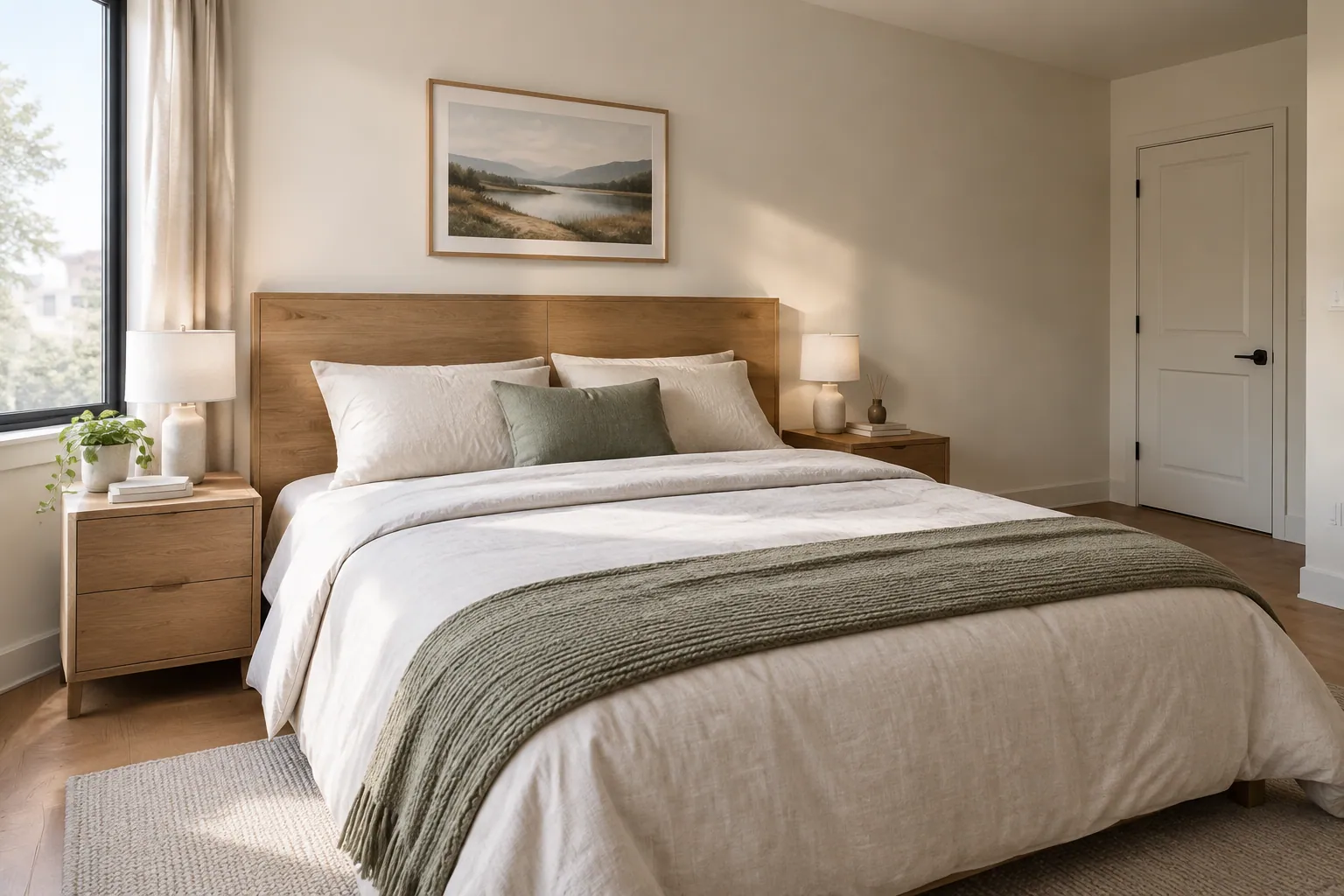
- Solid headboard fixed to the bed — Wood or firmly padded panel that meets the mattress without a big air gap.
- Tall solid panel — Still continuous and stiff; better than bars even if style is plain.
- Wall tapestry / padded board — Helps the eye and softens a blank wall; weaker than a true attached board.
- Nothing — Pillows against paint. Common, but the weakest rung.
If the only free wall has a large window, a taller solid board helps more than a low decorative strip—it cannot erase draft and light, but it restores a visual and physical backstop.
Materials and shapes that hold
Prefer continuous solid wood or a solid upholstered face; skip open bars, big cutouts, split halves, and sharp points aimed at your body. That is the practical core most careful guides agree on for a feng shui headboard.
| Choose | Skip or soften |
|---|---|
| Solid wood panel | Open metal bars / spindles |
| Firm upholstered board with a real core | Rattan, cane, or lace-like gaps |
| Soft rectangle or gentle curve | Triangle peaks and knife-edge points |
| One continuous piece for couples | Two twin boards shoved together with a gap |
| Calm neutrals if you want quiet sleep | Mirror or busy storage built into the board |

Metal nuance: a closed metal face is still less soft than wood or fabric, but it is not the same problem as a cage of bars. Open work is the bigger miss because support has holes in it.
Attachment: prefer a board mechanically fixed to the bed. A floating wall panel with a fist-sized gap above the mattress looks styled; it does less of the “backbone” job.
Height: the sit-up test
A useful headboard is tall enough that when you sit up to read, your upper back still has board behind it—not empty wall above a stub. Very low rails barely count; oversized cathedral pieces are fine if they stay solid and calm.
Skip magic inch rules from random tips. Use your body: sit where you sleep, lean back once, and notice whether something firm meets you.
No headboard: what you lose and what helps
Sleeping without a headboard is common and not a moral failure—but you give up the easiest layer of solid backing. Many people feel fine if the wall itself is strong and the bed is pushed flush. Trouble shows up when the head floats off the wall, sits under a window, or rests against a flimsy divider.
Honest substitutes, ranked:
- Push the bed flush to a solid wall tonight.
- Add a tall solid headboard attached to the frame when you can buy or build one.
- In a rental, a padded wall panel or heavy tapestry is a partial stand-in—secure it well; admit it is not equal to a real board.

Bed frame myths (and bedding)
A feng shui bed frame is the structure under the mattress; it is not a substitute for a headboard. Shopping results blur the two. Keep them separate.
- Myth: “Any metal frame ruins the room.” A simple metal base with a solid wood or upholstered headboard is a different setup from an open iron headboard of bars. Prioritize the backing face first.
- Myth: “A platform with no board is fine because the frame is wood.” Wood under you does not create support behind your head.
- Myth: “Feng shui bedding fixes a missing board.” Soft sheets and calm colors help the mood of the bed; they do not create structural backing. Treat feng shui bedding as comfort and quiet color—not as a headboard replacement.
Keep under-bed storage light and closed if you use it; clutter under the mattress is a separate tidiness issue from the board behind you.
Tonight’s 3-minute check
- Is there a real wall (not mostly glass) behind the pillows?
- Is there a solid board—or only bars / nothing?
- When you sit up, does the board still meet your back?
- Is the board attached to the bed, or floating with a gap?
Change one rung on the hierarchy this week. When you want the whole room—not only the head of the bed—open the bedroom feng shui layout guide and walk the door, walls, and bed as one plan.
FAQ
Must the headboard face a lucky compass direction?
Not for this article’s job. Backing and solidity come first. Personal direction systems are a different layer—handle them in a full bedroom plan, not as a shopping filter for the board alone.
Is a wall-mounted headboard “wrong”?
It is a compromise. Better than nothing if it is solid and almost meets the mattress; weaker than a board fixed to the bed. Close the gap if you can.
Are metal headboards always bad?
Open bars and spindles are the clear miss. A solid metal panel is a style choice with a cooler feel—pair it with calm bedding and judge your sleep for a week before you panic-replace it.