Feng shui office layout with window: light from the side, wall behind the chair

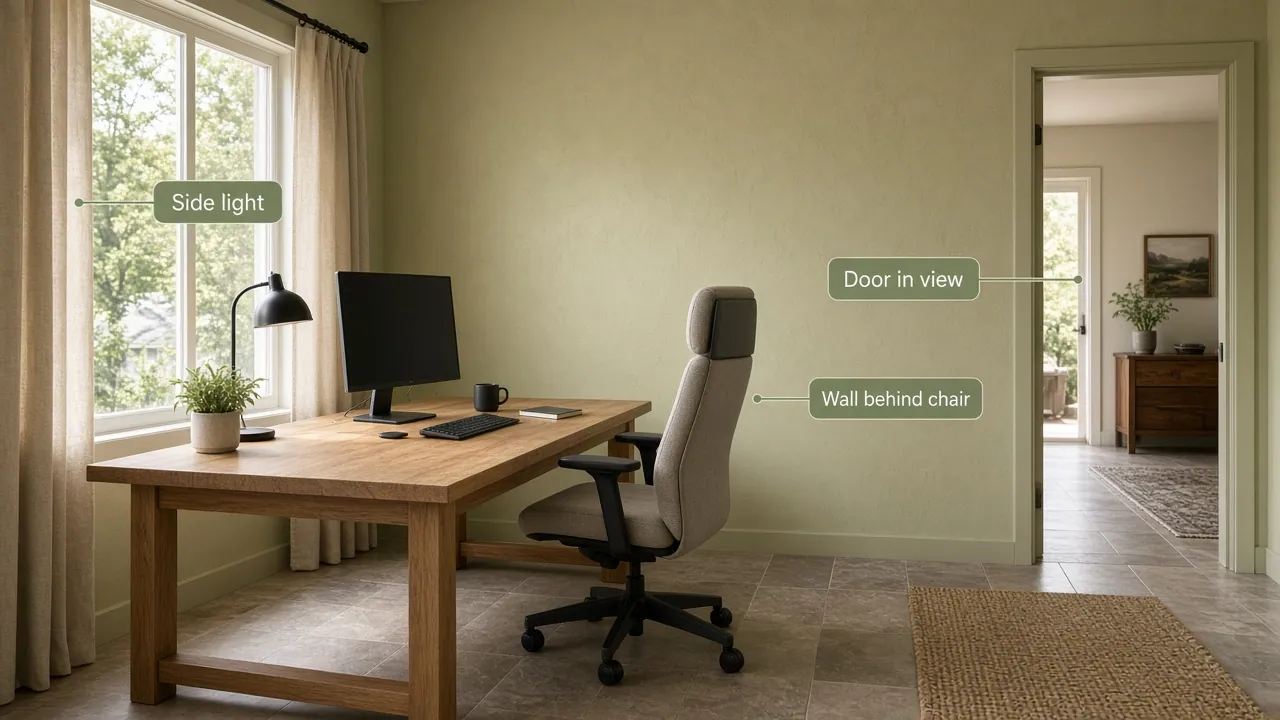
A home office with a window works when daylight sits beside the desk, a wall or cabinet backs the chair, and you can still see the door. Glass behind you is a compromise, not a luck charm.
Feng shui office layout with window is the usual renter problem: you want daylight to work, but a chair with only glass behind it feels exposed, and afternoon sun turns the screen into a mirror. Windows are not forbidden. Treat the window as light and air, not as a lucky wall. The chair still needs a real back—a solid wall, or at least a high-back chair plus a cabinet or screen. You still need to see the door without sitting in the path of whoever walks in.
This page is that window puzzle. Any-room desk geometry lives on desk placement. The whole room is on home office. To match your own plan, open Analyze.
Traditional study notes want a bright, quiet desk that gets sunlight but does not stare straight into the glass, with a wall behind the seat and the door in view but not aimed at your chest. That is the whole job.

What usually goes wrong
People hear “sit with a view” and push the desk flush to the glass, back to the room. It feels inspiring for an hour. A month later, hallway noise arrives from behind, and west sun paints the monitor white.
Keep three checks from the chair, blinds open:
- Can you see the doorway without twisting hard?
- Does anyone entering walk straight into your spine or the middle of the desk?
- Is there a wall—or a cabinet that reads as a back—behind your shoulders?
If keeping the view means losing the door, keep the door. A pretty window does not cancel a startled seat.
Put the window beside you
Side light is the layout that usually works:
- Daylight reaches the desk without turning your whole back into empty glass
- You can angle the screen away from glare
- Sheer plus a heavier drape lets you kill contrast without sitting in a cave
| Room | Try this first | If you cannot |
|---|---|---|
| Window on the long wall | Desk parallel to the window; chair against a solid short wall | Desk under the window only after you add backing |
| Corner of two windows | Sit in the solid corner; keep glass in the sides of your vision | Do not float in the glass L |
| Window opposite the door | Desk on a side wall so both openings stay in view | Soften the door path with a rug or a real screen |
Traditional desk notes also say: do not stare at the window all day (it pulls attention out), and do not sit under a beam.
When the window has to be behind you
Sometimes the only wall that feels solid is wrong for a screen, or the desk is fixed under the sill. Treat glass behind the chair as a known compromise, not a curse:
- Use a high-back chair, and a low bookcase or screen behind the shoulders if you can
- Layer sheer plus a denser curtain so you can kill glare and still keep daylight
- Do not also sit in the door’s straight path
- Keep the sill clear—stacks at neck height feel like pressure
One healthy plant to the side is enough. A row of fake plants does not replace a back.

Desk under the window
It can work when:
- The sill is high enough that you are not face-to-face with a busy street all day
- You can still see the door
- Glare is controllable (north light, trees, or shades)
- You still feel a back—chair height, a side panel, or a wall return
It fails when the window is floor-to-ceiling void with the door behind you, when draft hits your neck for hours, or when the desk blocks the only way out of a tiny room.
A bay window is for the work desk only if it is deep enough to sit in and the back of the bay still feels closed. Otherwise put a plant or a reading chair in the bay, and keep the work desk on a real wall.
Door and window on opposite walls
Many home offices have a door on one wall and glass on the other. That can make a tunnel across the chair: bright void behind, people arriving in front.
Slide the desk so the tunnel grazes a corner of the room, not your chest. Use a rug to mark the work square. Keep both openings clear—piles between door and glass make the room feel stuck.
If the only window is on the same wall as the door, put the desk on a perpendicular wall so both openings stay in awareness. Do not sandwich yourself between the door swing and the glass.
Screens, plants, night
Angle the monitor across the window, or slightly off, not dead into sunset. Blinds and sheers do not “break” feng shui; controllable light is the point. Sitting in blackout all day is a different problem—open during work hours when you can.
If this desk shares a bedroom, close the denser drape at night. Sleep wants a quieter, darker room. Night glass behind you still reads as a hole, not a wall.
Common questions
Is a window behind the desk bad? Weak backing, not a curse. Add mass, control glare, keep the door in view. Side light is still the cleaner default.
Should the desk face the window? Soft daylight ahead can feel fine. Harsh glare, a busy street, and your back to the door usually fail. Side orientation wins more often.
Do blinds ruin the layout? No. Use them. Closed blackout from morning to night in a cave is the problem, not the hardware.
Tonight
Sit where you actually work. Slide the desk so the window is on your left or right, check that you can see the door, and put a wall or a cabinet behind the chair if you can. For the whole room, open home office. To match your floor plan, use Analyze. Get the seat right before buying office charms.