Money Tree Feng Shui: Pachira Placement & Care Guide

Where to place a Pachira money tree for feng shui—SE wealth corner, entry caveats, braid myths, care tips, and how it differs from lucky bamboo.

Money tree feng shui usually means one houseplant: Pachira aquatica, the tropical tree sold with a braided trunk and hand-shaped leaves. Searchers also type pachira money tree feng shui or feng shui money tree placement when they want a spot that feels lucky and keeps the plant alive. This guide is only about Pachira—not jade, Chinese money plant (Pilea), or lucky bamboo.
You do not need a bagua lecture first. Start with light, drainage, and a clear path; then pick a wealth- or welcome-minded corner. When you want the wider home map later, open our home design feng shui hub; tonight, stay with one healthy tree in the right room.
What “money tree feng shui” means
In feng shui practice today, a money tree is almost always Pachira aquatica—a wetland tree from Central and South America, grown indoors for glossy compound leaves and, often, young trunks woven into a braid. The nickname spread in 1980s Taiwan as the plant became a gift for prosperity. Online lists lump many “money plants” together; for placement, treat Pachira as a soil-potted tree that likes humidity and bright indirect light, not a water-vase bamboo.
Traditional wealth work still expects a living, upright plant in a bright, tidy zone. A yellow, drooping tree sends the opposite message no matter what corner you chose.
Plant-First Placement: health, path, then purpose
Use three checks before you chase the “perfect” wealth corner: Health (bright indirect light + drainage), Path (never block the door or main walk lane), Purpose (wealth corner, welcome spot, or desk reminder). Call it Plant-First Placement (PFP)—it keeps money tree placement feng shui practical.
Southeast vs back-left wealth corner
Two schools disagree on the wealth spot:
| Method | How to find it | Best when… |
|---|---|---|
| Compass bagua | Real southeast sector of the home or room | You know room orientation; SE has a usable window |
| BTB / Western bagua | Back-left corner standing in the doorway, facing in | Open-plan rooms; you think from the entry |
Both are modern living-room conventions. Classical texts did not use the simple “diagonal from the sofa” shortcut popular in Hong Kong and Taiwan shops—and a bright wrong corner beats a dark “correct” one. If SE is a dim hallway, place the tree in the brightest back-left you actually use, or beside a well-lit entry instead.

Front door rules (and what they do not mean)
A money tree near the front door should sit to the side of the opening—welcoming energy without blocking the door swing or the first steps inside. That is what people mean by feng shui money tree at front door meaning: greet the home, not guard it like a gate.
Checklist:
- Keep the pot off the hinge side if space is tight; leave room for shoes and the door arc.
- Do not park it in the center of the threshold—qi (the felt flow of a space) needs a clear landing strip.
- Pair with a mat and closed shoe storage; clutter at the mouth of the home cancels plant symbolism faster than wrong compass degrees.
Living room and home office
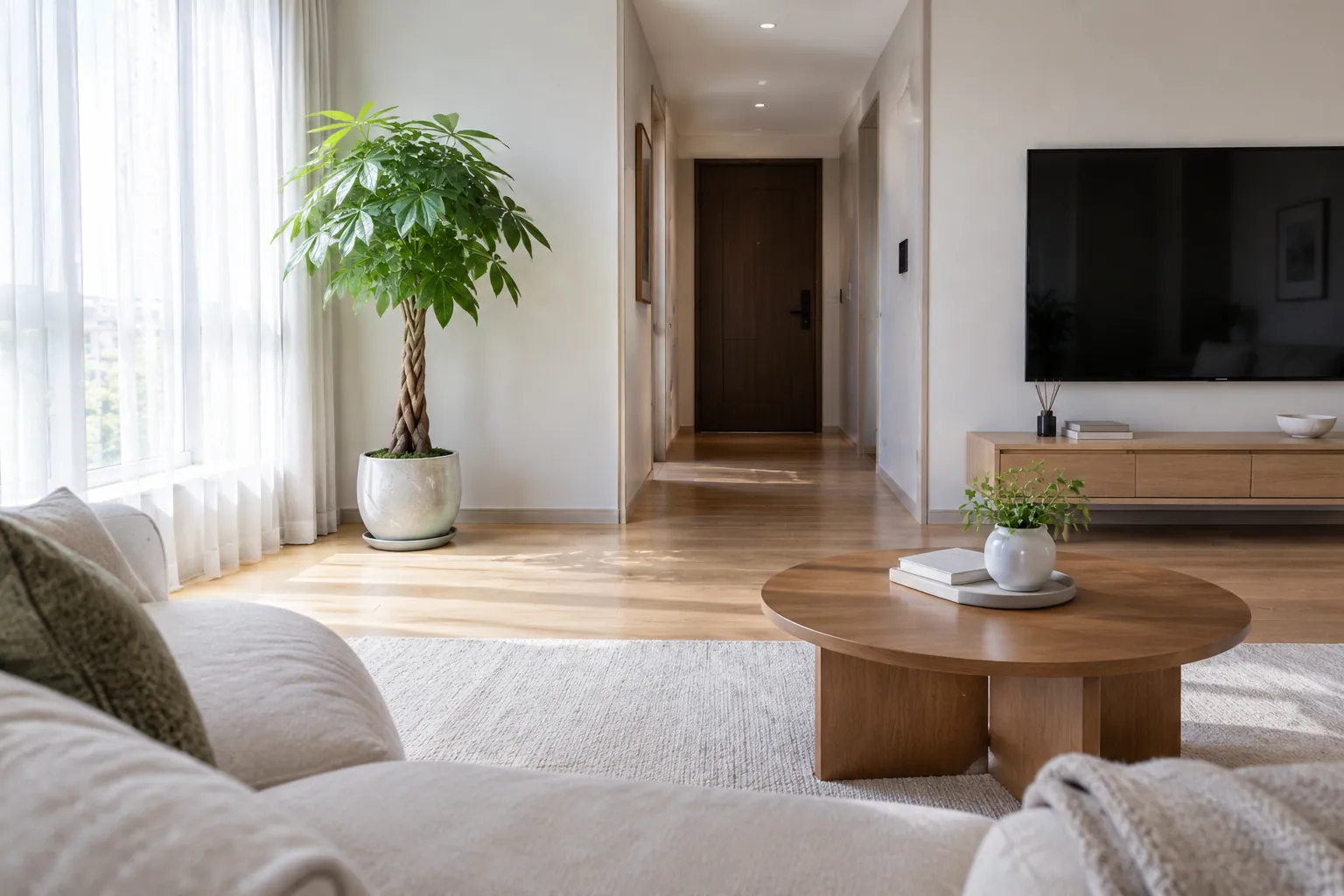
Living room: anchor the tree in your real wealth corner if light works—near a east- or north-facing window with a sheer curtain is ideal. Keep the area around the pot empty enough to dust and water.
Home office: a small Pachira on the desk or back-left of the room acts as a growth reminder. Face the desk so you can see the door without sitting in its straight rush; the plant should not hide the entrance.

Soft avoid: many practitioners skip bedrooms (too active for sleep) and bathrooms (symbolic “drain” imagery). If your only bright spot is a bathroom with a window, prioritize plant health over strict rules—and move it when you find a better room.
The braided trunk: nursery craft, later story
The famous braid is not an ancient feng shui symbol—it is a 1980s Taiwan nursery technique of weaving flexible young trunks together before they harden. Botanic references note the wild tree grows a single trunk; the braid was marketed to “lock in” luck after the style took off.
What to tell yourself:
- Three stems are often sold as “new beginnings”; five stems as balance—retail stories, not classical requirements.
- Five leaflets on a stem are read as the five elements (wood, water, fire, earth, metal)—a modern, catchy reading.
- A single-stem, unbraided Pachira is still a valid feng shui plant if it is healthy and well placed.
You are not missing fortune if you buy a plain trunk; you are avoiding a myth that the braid alone does the work.
Care so the symbolism stays believable
Keep the top 2–3 inches of soil dry before watering again, give bright indirect light, and use a pot with drainage holes—otherwise “wealth energy” is just a rotting root ball. Pachira tolerates average indoor humidity but perks up near 50%+ (bathroom with a window, pebble tray, or grouping with other plants).
Quick care map:
- Light: east or pulled-back south/west window; no midday sun on leaves.
- Water: soak until a little runs out the bottom; empty the saucer; wait until the top feels dry.
- Temperature: roughly 65–80°F (18–27°C); keep away from heater blasts and cold drafts.
- Signs: yellow leaves often mean too much water; crispy tips mean dry air or underwatering.
A thriving tree reads as steady progress; a struggling one reads as neglected priorities—practitioners say that part out loud.
Money tree vs lucky bamboo (sibling, not duplicate)
Pachira and lucky bamboo both show up in “money plant” lists, but they do different jobs: Pachira for wealth corners and living spaces in soil; lucky bamboo often near the door for career uplift in water.
| Pachira (money tree) | Lucky bamboo (Dracaena sanderiana) | |
|---|---|---|
| Medium | Soil, drainage | Water vase or very wet soil |
| Common feng shui use | SE / back-left wealth, living room, office | Near entry for career progress |
| Look | Braided woody trunk, broad leaves | Straight stalks, narrow leaves |
| Care risk | Overwatering / root rot | Stagnant water, algae |
Traditional Chinese home texts praise 开运竹 / 富贵竹 at the main door for career momentum—upright stalks, proportional to the door, without blocking passage. That is not the same as parking a large Pachira in the threshold. Many homes do both: slim bamboo at the entry, Pachira in the bright living wealth corner.
Tonight checklist
- Confirm you have Pachira ( braided or not ), not jade or Pilea.
- Walk the door path—if the pot forces a sidestep, move it to the side table.
- Find the brightest back-left or southeast corner you actually sit in.
- Water only when the top soil is dry; check the saucer is empty an hour later.
- Wipe dust off leaves—dull foliage looks neglected in photos and in person.
If two corners tie on light, pick the one you see when you pay bills or unwind after work; intention plus a healthy plant beats compass anxiety.
FAQ
Where should I put a money tree for feng shui?
Put it where it gets bright indirect light first. Then align with the southeast wealth sector (compass bagua) or the back-left corner from the doorway (BTB bagua). A side spot near the entry works when wealth corners are too dark.
Does the braided trunk matter for luck?
The braid is modern horticulture, not an ancient ritual. It can still feel meaningful as unity or “holding” prosperity—optional symbolism, not a requirement.
Can a money tree block the front door?
No. It should not sit in the door swing or the main walking lane. Place it beside the entry so the path stays clear.
Is a money tree the same as a money plant?
“Money plant” is an umbrella term. Jade (Crassula), Chinese money plant (Pilea), lucky bamboo, and Pachira all appear on lists. This article is about Pachira money tree feng shui only.
Money tree or lucky bamboo at the door?
Lucky bamboo is the classic door-side career plant in many Chinese feng shui sources. Pachira fits better in a bright living wealth corner or office; at the door, keep it to the side and smaller so passage stays open.
When you are ready to see how plants fit with colors, entry flow, and room-by-room layout, browse home design feng shui for the next layer—after tonight’s tree is watered and in the light.