Feng Shui Bed Facing North: Calm Myths vs Cold Yin

Is a feng shui bed facing north good or bad? Sort calm-sleep claims vs cold-yin warnings, then use a form-first layout rule before the compass.

A feng shui bed facing north is not automatically lucky or cursed—it is a sleeping-head orientation whose popular meanings collide, so room geometry should decide before the compass does. Searches for feng shui bed position north or bed facing north feng shui are asking the same job: can I keep my head pointing north tonight without buying a superstition?
This page stays on the north question. For a full compass atlas, start with the bed-direction guide. For door-and-wall geometry alone, use the command-position checklist. South- and east-facing posts answer those directions in depth; here they appear only as a short contrast.
What “bed facing north” means
In plain terms: your head points north while you sleep—usually because the headboard sits on the north wall. That is the feng shui bed position north people mean. It is not “the bedroom window faces north,” and it is not “the door opens toward the north side of the house.” Sit at the pillows, face the foot of the bed, and read a compass; the heading in front of you is your sleeping-head direction.
If that reading is north, you have a north-facing bed in the language of this article—even if the room’s front door faces east.
The calm verdict
North can feel calm in some traditional stories and “too still” in others; treat both as folklore layers, keep a safe layout first, and only then ask whether north fits you. There is no single school that owns the last word online—one page will praise stillness, another will warn about cold yin, and a third may import Vastu’s “never sleep with the head north.” Your lease and your door line are more honest than any of those slogans.
If a north wall fails the safety checks below, skip the myth debate and move the bed.
Myth ledger: good sleep vs cold yin vs “never north”
The same north orientation is sold as deep rest, drained yin, or a hard ban—those claims cannot all be universal laws. Reading them side by side is the information gain; picking one blog’s absolute is not.

| Story you will hear | What it usually claims | How to hold it |
|---|---|---|
| Calm / still / “water” rest | North soothes a busy mind; good for deep quiet sleep | Traditional association language; fine as a feeling hypothesis |
| Cold / stagnant yin | North is too passive; may leave you heavy or unmotivated | Same compass, opposite spin—watch your own energy for 1–2 weeks, do not diagnose disease |
| Vastu-style “never north” | Head north fights earth magnetism; prefer south or east | A different tradition; do not paste it onto form-school Chinese layout without saying so |
| Personal lucky/unlucky lists | North helps some birth-based direction groups and challenges others | Secondary filter after layout; partners often disagree |
Popular charts also disagree with each other: some list north as harmonious, others as the direction to avoid. That clash is normal. It is why this site’s bed-direction article refuses a single “best arrow for everyone,” and why this north page refuses a medical-style guarantee.
Form-first rule before the compass
If keeping a north head forces you under a window, into the door’s straight rush, or with your back to the entrance, keep the safer wall and drop perfect north. Form-school bedroom practice treats three checks as the gate:
- From the pillows, can you see the bedroom door with a small eye turn?
- If someone walked straight in, would they walk over your feet?
- Is there a real wall and a serious headboard behind your head—not glass pretending to be one?
Only when a candidate wall passes (or is the least-bad survivor) do you ask, “Does this wall also give me north?” That is the form-first rule. A feng shui bed facing north that fails the gate is a compass win and a sleep loss.

When north can make sense (and when to skip it)
North is worth keeping when it sits on a survivor wall and the room already feels quietly supportive—not when you are chasing a viral tip through drywall. Soft reasons people keep north: they like a stiller evening mood; a personal direction system they actually follow lists north as favorable; or north is simply the only solid wall that clears the door line.
Skip forcing north when: every north option puts you in the coffin line; the headboard would hang under a window or heavy beam; you already feel heavy and flat in that spot after honest trial nights; or a partner’s workable wall is east or south and shared sleep matters more than your chart.
Personal direction systems (often taught with a Kua / East–West group) can mark north as helpful or challenging. Use them as a tie-breaker among safe walls—not as a reason to sleep in the doorway.
North vs south vs east (short contrast)
North is the “still water” story; south is often sold as warmer vitality; east as growth and morning energy—none of those labels beat a bad layout. Keep this table short on purpose.
| Head points… | Common popular story | Not this article’s job |
|---|---|---|
| North | Calm, reflective, strongly yin | Full myth deep-dive ← you are here |
| South | More yang / recognition heat in many charts | See the south-facing sibling when published |
| East | Fresh start / rising energy in many charts | See the east-facing sibling when published |
For measuring method, conflicting full charts, and the survivor-wall workflow across all directions, open the general bed direction feng shui guide. For door geometry alone, use feng shui command position. For whole-room ranking without a north obsession, see bed position feng shui.
If your only solid wall is north
Keep the north headboard, fix what you can see, and stop apologizing to the compass. Practical softens that do not require knocking out walls:
- Use a tall, solid headboard tight to the wall.
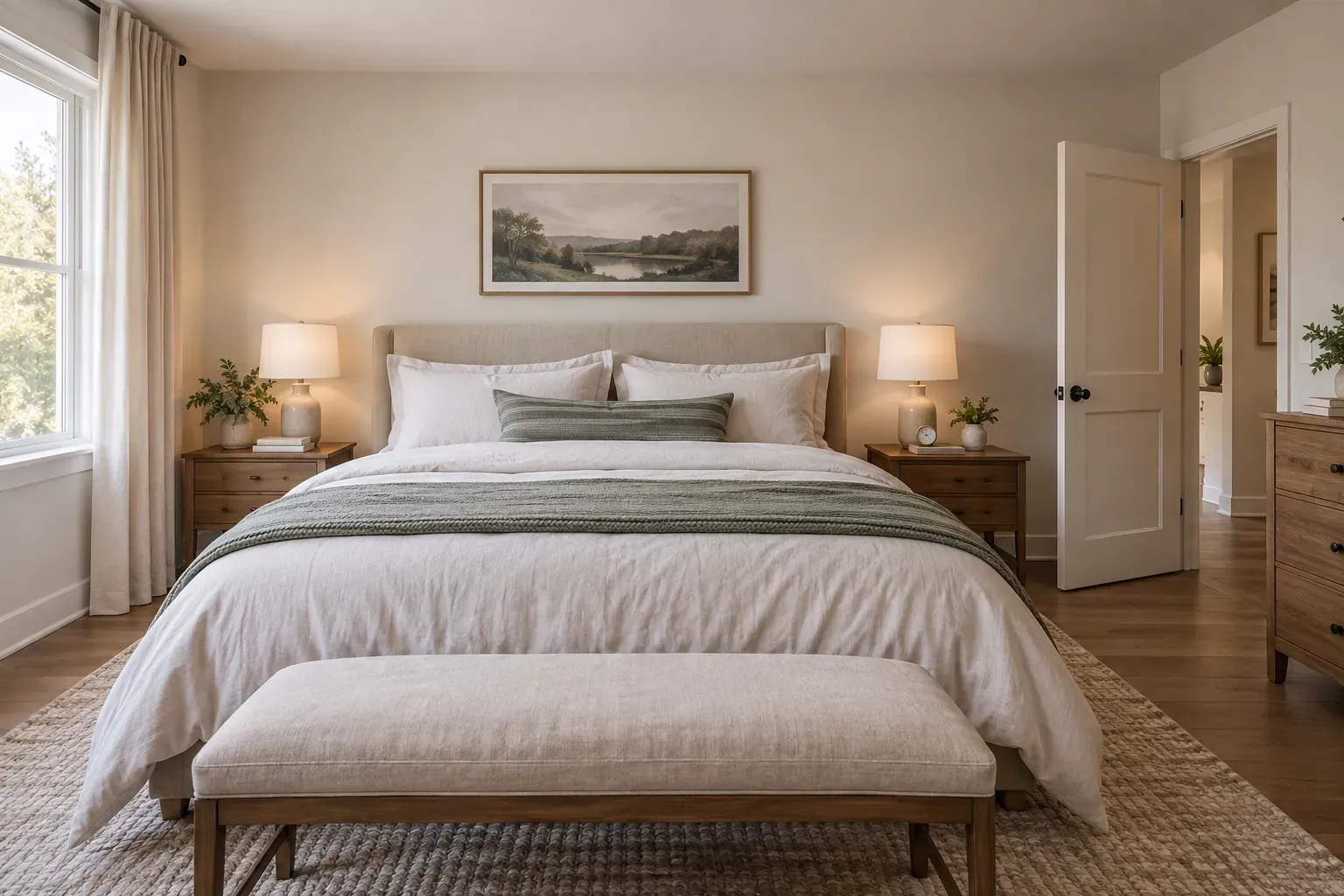
- Soften a near door line with a low bench, chest, or rug buffer at the foot—not a pile of laundry.
- Keep the under-bed zone clear enough that the room can “breathe.”
- Warm the visual temperature with soft lamps and earthy textiles if the north wall feels chilly to you—comfort cues, not magic.
- Cover or angle mirrors so they do not throw your sleeping body back at you all night.
None of these steps “cancel” a direction like a spell. They make a forced north layout more livable while you protect the form basics.
FAQ
What happens if your bed faces north?
Nothing automatic happens—you get a north sleeping-head orientation whose meaning depends on which tradition you are reading and how safe the layout feels. Some stories predict calm rest; some predict sluggish yin; Vastu-influenced pages may predict poor sleep. Watch how you actually fall asleep and wake for a week or two instead of treating any one claim as a diagnosis.
Is bed facing north bad feng shui?
No—not as a universal rule. Bed facing north feng shui advice online splits in half. Bad layouts (door rush, window-backed head, no support) are a clearer problem than the word “north.”
Is feng shui bed position north the same as a north-facing bedroom?
No. A north-facing bedroom usually means the room’s windows or the home’s facing sit toward north. Feng shui bed position north means your head points north on the mattress. Measure the pillows, not the facade.
Tonight checklist
- Confirm what “north” means at the pillows with a compass app (away from thick metal frames).
- Run the three form checks on every solid wall.
- Keep north only if it survives—or if it is the least-bad survivor you can soften.
- Ignore absolute health scare copy; notice your own rest for a short trial.
- When you want a whole-bedroom layout pass—not only a compass debate—open the bedroom feng shui design page and map the door, windows, and bed together.
A north headboard can be a quiet ally or a forced compromise. Form first, myths second, and let your real nights—not a viral chart—cast the deciding vote.