Bagua Map for Home

A bagua map overlays nine life areas on a floor plan. Learn entry versus compass placement, missing corners, and why room geometry still comes first.
Search bagua map for home and you often get a wealth-corner sticker or a door mirror. The older tool is plainer: a nine-cell overlay on a floor plan. This page stays on that overlay. You will see how the eight trigrams become a tic-tac-toe grid, how Black Hat / Western entry placement differs from later-heaven compass placement (the chart Juhe uses after you set facing), and why form school still comes first. Dedicated wealth-corner how-tos live on wealth corner. Bedroom command-position rules live on Home Design. Here the job is to make the map honest enough that those tools do not fight your walls.
A bagua map overlays nine life areas
A bagua map for home is a nine-cell overlay: eight trigrams around a center, laid on a floor plan so each cell names a life area—career, knowledge, family, wealth, recognition, relationships, children, mentors, plus health at the middle. It is a template for reading a plan, not a mirror you hang on the door. You use it after you can name the door you walk through and the rooms you actually inhabit.

A bagua overlay is a 3×3 grid on a plan. Mark the door you actually use before you name any “corner.”
The nine palaces are not a bagua mirror
Bagua (八卦) means eight trigrams. Classical charts add a ninth cell—the center, earth and health—so the working tool is a nine-hall square, not an octagon you nail above the letterbox.
The eight names are Kan, Gen, Zhen, Xun, Li, Kun, Dui, Qian. Each carries a direction, an element, and a life theme. Teachers also call the cells stations of life. The Lo Shu magic square is the older 3×3 of numbers 1–9 (every line sums to 15). Compass school and flying stars sit on that number grid. A home bagua map borrows the same nine seats and fills them with aspirations. Same skeleton; different job.
A bagua mirror—the round, often octagonal object sold for “sha”—is a different artifact. Hanging one does not place the map. If the landing is blocked or the bed sits in the door’s rush, the mirror does not rewrite the plan. See what is feng shui for why geometry is the first language.
Nine life areas on the grid
English station names below match how Juhe labels Analyze after you choose a facing. Traditional gua names sit in the same cells. The center is not a separate palace object in the product list; it is still the ninth hall you must draw.
| Palace (later heaven) | Gua | Station (EN) | Theme notes |
|---|---|---|---|
| North | Kan 坎 | Career | Water; work and path |
| Northeast | Gen 艮 | Knowledge | Study, cultivation |
| East | Zhen 震 | Family | Health of the household line |
| Southeast | Xun 巽 | Wealth | Wood; resources—finder lives on the wealth-corner tool |
| South | Li 离 | Recognition | Fire; how you are seen |
| Southwest | Kun 坤 | Relationships | Earth; partnership |
| West | Dui 兑 | Children | Metal; offspring and making |
| Northwest | Qian 乾 | Mentors | Helpful people and career support |
| Center | — | Health | Earth; the connector that touches all eight |
Opposite cells support each other through the center. That is a reading aid, not a reason to decorate every wall at once.

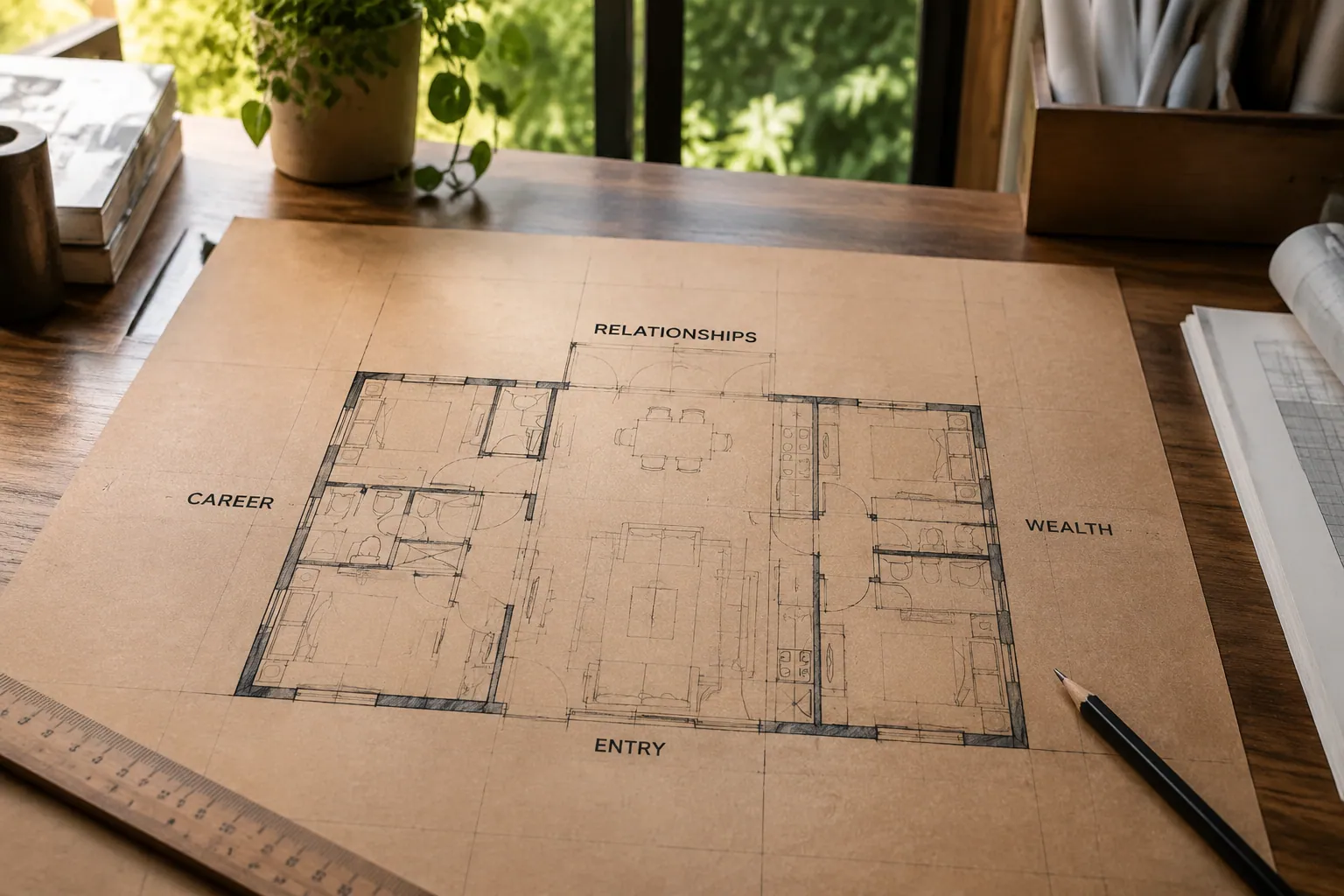
Western / Black Hat sketch: career along the entry wall; wealth and relationships at the far corners. Compass later-heaven pins the same names to magnetic north instead.
Two ways to overlay—and why they fight
Written feng shui does not share one overlay. Two habits show up in every beginner book. Juhe names both.
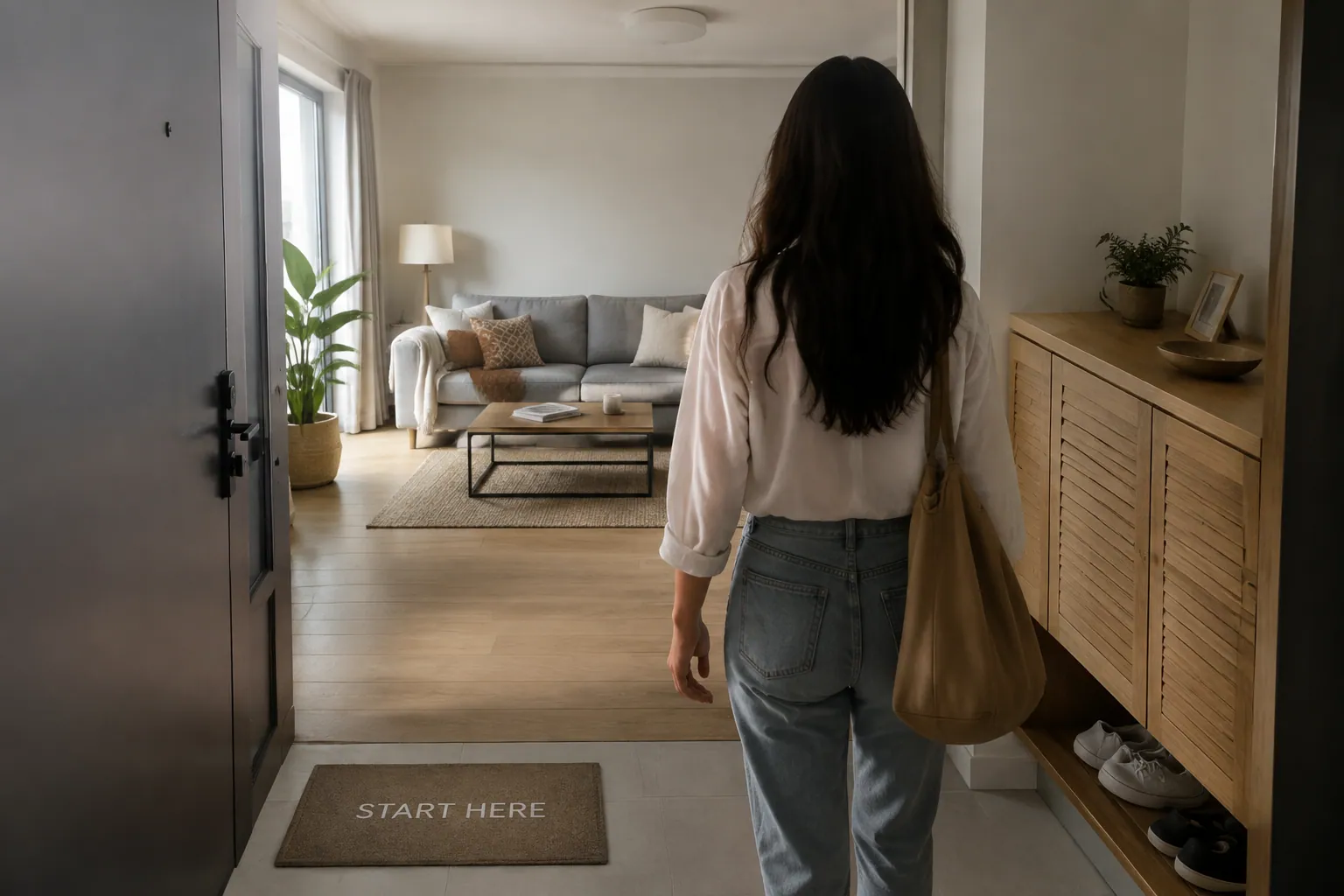
Western / Black Hat (entry overlay). Align the front of the grid to the wall that holds the door you use most. Career sits on that wall (bottom-center of the sketch). Knowledge is bottom-left as you look in; mentors bottom-right. Wealth and relationships sit at the far left and far right corners. You do not need a needle.
Compass / later-heaven. Palaces are fixed to magnetic directions. North is always Kan/career/water; northeast Gen/knowledge; east Zhen/family; southeast Xun/wealth; south Li/recognition; southwest Kun/relationships; west Dui/children; northwest Qian/mentors. The door can land in any palace. Juhe’s detector uses this chart after you set house facing. If facing is unknown, the overlay is marked schematic only—we do not invent north.
A third split sits on floors. SantoPietro places a new overlay per floor, keyed to that floor’s entrance. Lin Yun’s Black Hat teaching often keeps one map for the whole building. We do not pretend those are the same rule. For a renter on one floor, use that floor’s door. For a stacked house, pick a method and write it on the sketch so you do not mix them mid-week.
| Entry / Black Hat | Compass / later heaven | |
|---|---|---|
| Aligns to | Most-used door wall | Magnetic north (Kan at N) |
| Career sits | On the entry wall | Due north |
| Wealth sits | Far left from the door | Southeast |
| Needs facing | No | Yes |
| Juhe beginner use | Sketch to partition a plan | Analyze scoring after you enter facing |
| Fails when | You switch doors every week | Steel, wiring, or unknown facing |
Juhe’s order for readers:
- Form school first—door, bed, path—as on What is feng shui.
- Self-study overlay: one nine-cell sketch from the door you actually use, as a partition draft.
- Scored overlay: in Analyze, enter facing and use later-heaven palaces.
- Missing corners get their own paragraph. Do not “cure” them with charms as a health promise.
House facing is the input for step 3, not a substitute for step 1.
How to lay the map on your plan
- Draw the plan. Walls, the door you use, windows. For an apartment, draw the unit, not the whole block. Include a garage if it is part of the heated footprint you live through.
- Find the center. If the shape is irregular, square off missing bites in pencil so you have an imaginary rectangle. Diagonals from the four corners of that rectangle cross at the center—the health hall.
- Choose one alignment and label it on the page: “entry, kitchen door” or “compass, facing south.” Do not run both on the same unmarked tracing.
- Drop the 3×3. Stretch or shrink the grid to the rectangle. Name the nine cells. Then look at which rooms fall in which cells—not which poster you will buy.
Without a compass, sun rise still gives east for a rough later-heaven sketch. If that guess is weak, stay on the entry overlay until Analyze has a facing.
Missing corners and projections
An L-shaped plan will leave one or more stations outside the real walls. That is a missing bagua station, not a moral failure.
Spruill’s size rule is useful as geometry, not as magic:
- A projection smaller than about one-third of that side strengthens the station it belongs to.
- A projection larger than one-third behaves like a missing piece on the opposite side of the grid.
Owners sometimes complete a missing bite outdoors: a tree, a stone, a planted corner at the intersection. Renters should not wait on outdoor planting. Use the palace inside what you control: clear it, light it, actually use that room. Symbolic sketches and intentions are optional; they are not a medical patch. Traditional body-to-gua lists in some books are memory aids for “this zone is neglected,” not diagnosis. Health questions belong with a clinician.
Mirrors in every corresponding corner of every room are a common textbook patch for a missing west (children). Treat that as optional emphasis after clutter and daylight, not as a requirement.
Change one life area at a time
The map tempts you to “activate” all eight stations in a weekend. That produces a house of slogans and the same blocked door.
Pick one station that matches a real aim this month. Declutter that cell first, then add one object or one use (a lamp you switch on, a desk you sit at). Five-element color language—wood, fire, earth, metal, water—can tint the choice later; it does not replace emptying the pile. See five elements.
If two stations both feel urgent, still sequence them. Opposite-station pairing is a reminder that the center (health, circulation, the shared floor) connects them. Clean the connector; do not buy two posters.
Room geometry still comes first
A worked example: the same two-bedroom flat.
Map A (entry overlay). From the main door looking in, the far-left cell is wealth. On this plan that cell is the kitchen.
Map B (later heaven). Facing is known; southeast is a bedroom. Wealth “moves” onto the mattress.
The maps disagree because they answer different questions: “relative to the mouth of qi” versus “relative to magnetic north.” Neither map relocates the bed. If that bedroom bed sits on the door’s rush with no wall behind the pillow, a wealth poster in the kitchen (A) or a plant in the southeast (B) does not fix sleep. Tonight, move the bed (or break the rush). Activate a wealth cell after the room can be used. Form school does not wait for the overlay to pick a winner.
The same holds for any room page: Home Design still ranks backing, door view, and path above a labeled corner.
What a bagua map is not
It is not the octagonal mirror. The overlay is a drawing.
It is not a medical chart. Illness names tied to guas in some health-assessment books are not clinical evidence.
It is not permission to skip facing when you want a scored compass reading—and not permission to fake north when you do not have it.
It is not a bedroom tutorial. Command position is a form-school rule that applies whether wealth sits in that room or not.
FAQ
Should I start from the front door or from north?
For a hand sketch, use the door you use most (the front door wins a tie). For Juhe Analyze scores, enter facing and use later-heaven palaces. If you do not know facing, keep the bagua schematic; do not guess.
One map per floor, or one map for the whole house?
Schools disagree. SantoPietro: each floor follows that floor’s entrance. Lin Yun Black Hat: one layout for all floors. Label which rule you are using. A single-level rental is the easy case: one door, one grid.
What if a corner is missing?
Name which station falls outside the walls. Renters: use, light, and clear the nearest real room in that palace. Owners may extend the outline outdoors. Do not treat charms as a health cure for a missing gua.
How does this relate to the Lo Shu?
The Lo Shu is the 3×3 of numbers that sum to 15. The home bagua sits in those nine seats. Flying stars move numbers through the same square over time. You can overlay life-area names without running a star chart; you should not mix an unlabeled entry map with a star chart and call them one reading.
Do I need to buy a bagua mirror?
No. The map is the grid on the plan. A mirror is an object some traditions use for other jobs. It does not place Kan or Xun.
Is the wealth corner the same as this page?
No. This page is the whole overlay. Wealth corner is one station (Xun / southeast on the compass chart; far-left on an entry chart). Do not treat wealth as the only cell that matters.
Next step
Keep one picture: a tic-tac-toe on your plan, labeled with one alignment method, drawn after the door and the bed are livable. Then either continue the Knowledge path or put facing and walls into Analyze.
Synthesized from Juhe’s feng shui knowledge base: bagua as eight trigrams plus center; entry versus compass placement; SantoPietro per-floor versus Lin Yun whole-house overlays; mapping steps and irregular plans; missing stations and Spruill’s one-third projection rule; stations of life; Lo Shu as the numeric nine-hall square. Traditional body and illness correspondences are not used as medical claims.