Feng Shui for Beginners

A learning path: thirty minutes to see qi in your doorway, then yin-yang, form school, five elements, and the bagua map—before you touch a room guide.
How to start feng shui as a beginner
If you are searching how to start feng shui as a beginner, skip the shopping list. This page is a learning path: what to study first, what to do tonight, and when to open a room article. The definition of wind-and-water, qi, and the two schools lives on What is feng shui. Here the job is order.
Do not start with a bagua grid or a birthday compass. Stand in the doorway you actually use, match rest to quiet, then rank door, stove, and bed—and change only the worst of those three. Kits and bagua mirrors come later, or not at all.

Start where people arrive: a door that can open, a path that turns, a seat with a wall behind it.
A thirty-minute path you can tick
Set a timer. Do these five in order. If a step is already fine, tick it and move on. Do not “improve” a room that is not the bottleneck.
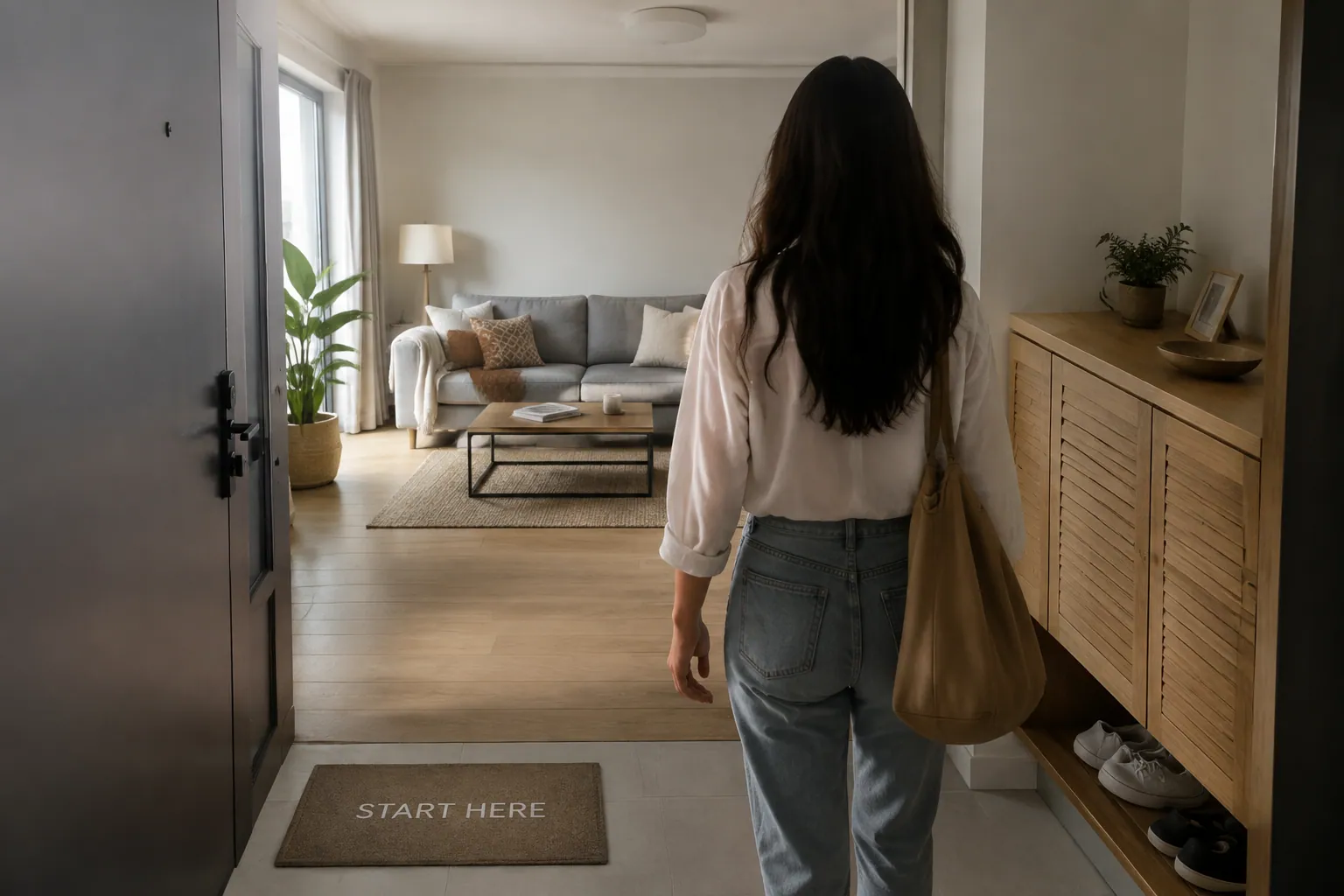
1. Stand in the door you really use and read the mouth of qi.
Not the unused lobby door. The one your keys hit. Can it open fully? If shoes, a pram, or mail stop the swing at sixty degrees, that is a blocked throat. Then look in: does a straight line shoot to a sofa, bed, or TV? A dart is harsher than a path that turns once. Example: a 45 m² rental, entrance facing the sofa at 4 m. Tonight you do not buy a fountain. Angle the sofa or add a low console that forces a step left. Photograph the landing—that is your first qi reading. Mouth, path, dead corners: What is feng shui.

The door you use is the mouth. Clear swing, then a turn inward—not a bowling alley.
2. Mark tonight’s rest room as too yang or too yin.
Lights, screens, backing. A bedroom with a glass wall, a laptop on the nightstand, and a TV at the foot is too yang for sleep. A spare room with blackout blinds, no lamp you can reach from the pillow, and a bed floating in the middle with a window void behind the head is too yin and unsupported. Write one sentence: “This room’s job is rest; the stimulus is high/low; the back of the bed is solid/void.” Do not recode the walls with five-element paint tonight. The yin-yang test and the room-job table are on the definition page.
Command position—seeing the door without lying in its rush, solid wall behind the pillow—is one sentence in this path, not a bedroom chapter. If the bed fails it, the how-to is bedroom feng shui.
3. Rank door, stove, and bed. Change the geometry of only the worst one.
Interior teachers (Harijanto’s interior priorities among them) put main door, kitchen/hearth, and bedroom first because they are how the house takes people in, how it feeds, and how it rests. Score them crudely: 1 = livable, 3 = fight every day. If the door cannot open and the stove is fine, you do not rearrange pots. If the bed is in the door’s rush and the entry is already clear, you move the bed or break the line—you do not hang a bagua mirror in the hall “for wealth.” One geometry change beats three symbolic objects.
Example: a couple cooks well (stove has a wall behind, path to sink is open) but sleeps with feet pointing at the bedroom door and no headboard wall. Worst piece = bed. Tonight: rotate or shift the mattress off the axis. Leave the kitchen alone until the bed is off the dart.
4. Do not buy a “five-element set” or a bagua mirror before you have studied those maps.
Webster-style beginner books still walk form before compass charts. A metal turtle on a blocked landing does not open the door. A mirror facing the street can bounce glare and start a neighbor fight; it is not a substitute for a turning path. If you want the later languages, they have their own pages: five elements and the bagua map. Until then, spend the money on a closed shoe cabinet or a headboard that actually backs the pillow.
5. If you want your own plan scored, use Analyze—self-serve, not a booking.
Juhe is not a visit calendar. You capture walls, get form-school scores, and get a task list. Run it after the thirty minutes if you cannot tell which of the three pieces is worst, or before you spend on furniture you cannot return. It is a check, not the first lesson.
Tick all five and stop for tonight. Learning continues below; shopping does not.
Three ideas you actually need (then stop copying definitions)
Connie Spruill’s “Big Three” in a practical Western book are Tao, yin-yang, and chi. On this site we keep the beginner stack even shorter and geometric: qi, yin-yang, and form school. Classical kan yu—surveying land and settling a dwelling—is the older name for the same habit: look at weather, entry, rest, and backing before you look at a chart. Full definitions and the worked apartment examples stay on What is feng shui. Here is only how they sit on the path.
Qi, as a homework, not a particle. After step 1 you already have a sentence: blocked mouth, dart, or usable turn. Supportive flow is slow enough to arrive; harsh flow is a straight rush (teachers say sheng qi versus sha qi—you can say supportive versus harsh). You do not meditate qi into the sofa. You change the path.
Yin-yang, as a job match. After step 2 you know whether rest is over-lit. Yang is movement, light, heat, greeting; yin is rest, shade, storage. A kitchen that is too yin will not feed you; a bedroom that is too yang will not sleep you. Color charts wait.
Form school before compass school. Form school (形法) reads shape: hills and water outside; doors, paths, backing, and beams inside. Compass school (理气) wants facing, time, and often a birth date. In a steel rental the needle lies; the door still either opens or it does not. Juhe starts with form. Command position is a form rule for bed and desk—diagonal view of the door, not the coffin line—taught in room guides, not here.
If form and compass disagree on the same bed, fix the rush and the backing first. Personal directions are a later slice.
Then five elements—and only then the bagua
When to learn five elements. After the thirty-minute path, and after you can say which of door / stove / bed is worst. Wood, fire, earth, metal, and water are a language for materials and room roles, not a reason to buy five bowls. Open five elements feng shui when you are choosing finishes, a plant versus a lamp, or why a kitchen already “has fire” and does not need a red wall. If you still cannot sleep because the bed faces the door, elements will not outrank geometry.
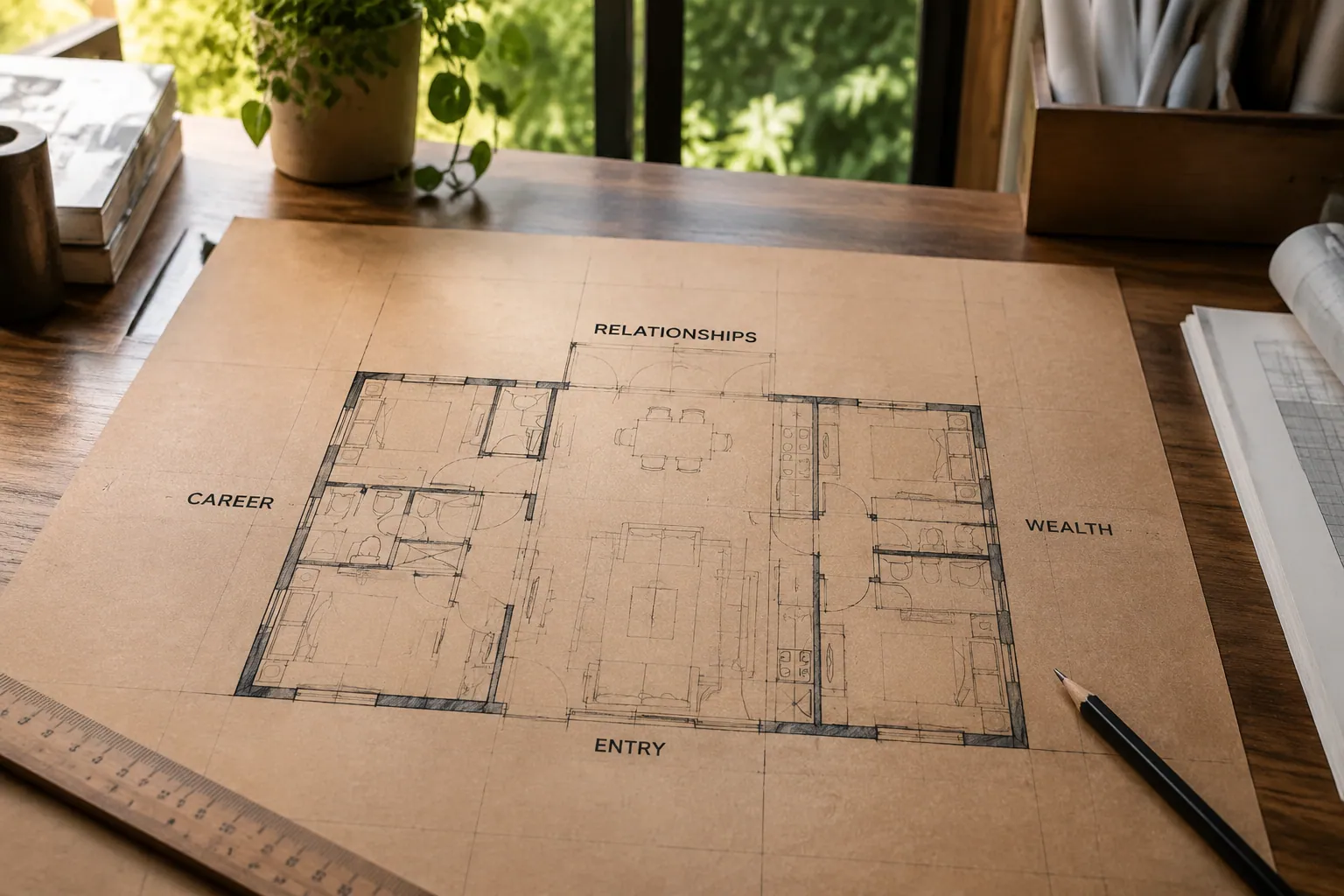
When to learn the bagua. After elements, or in parallel if you already know your floor outline. The bagua map overlays eight life areas on a plan. Some people align it to the entry (a western / Black Hat habit); others to magnetic north. That debate is on the bagua page. Do not tape a career corner onto a blocked door. The map is a second pass on a house that already takes people in and lets them rest.
Webster introduces pa-kua and elements after chi and yin-yang. Follow that order even if a shop puts the octagon in the window. The encyclopedia is a glossary, not week-one reading.
Learn by room (links only)
Once the path and the three ideas are in your hands, room-by-room how-tos live on Home Design—not in another beginner essay. Open the page for the room you actually live in:
- Bedroom — command position, mirrors, equal sides; master and guest are separate if you need them
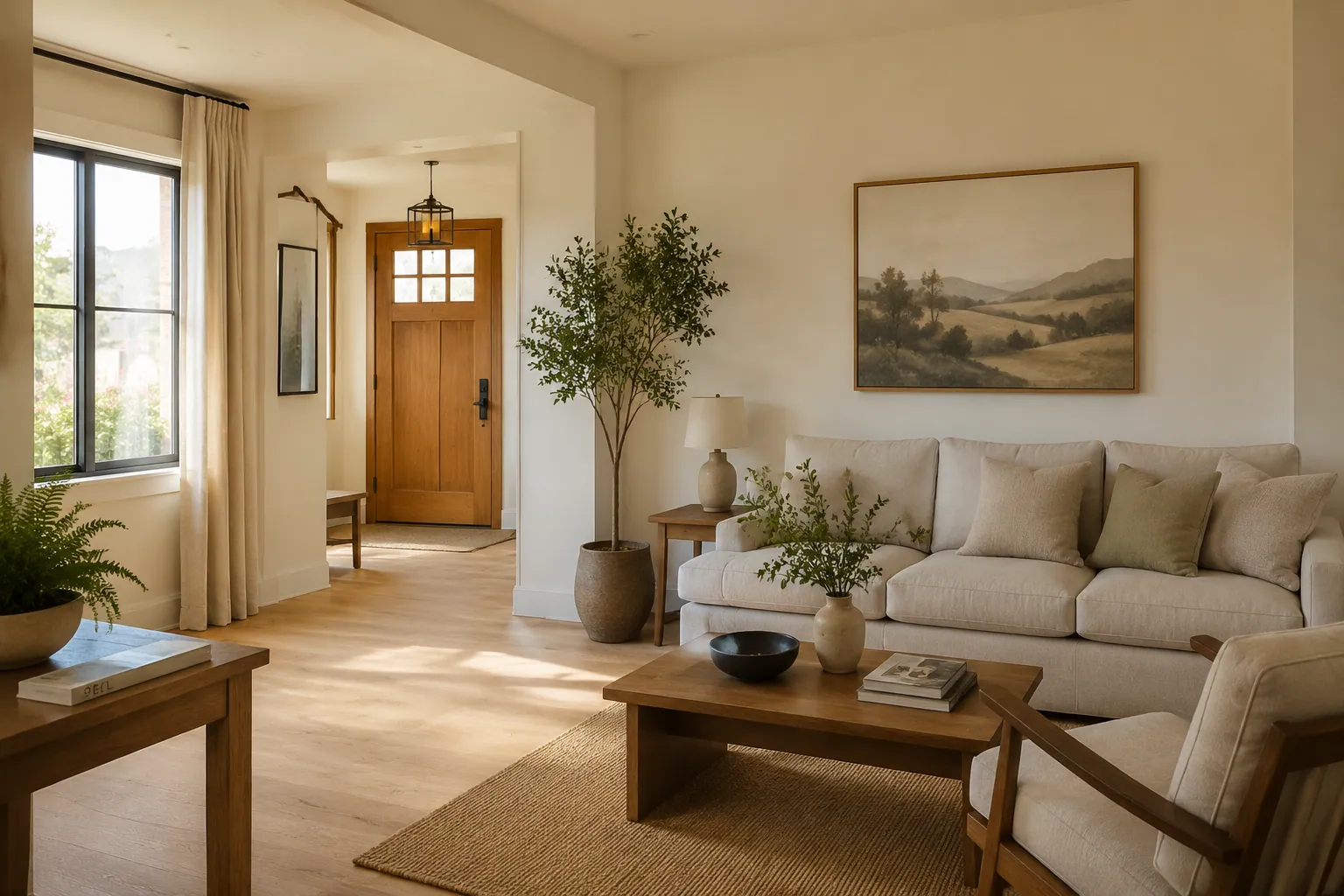
- Living room — sofa backing, door view, TV as a yang spike
- Kitchen — stove, sink, and the path between them
- Bathroom — moisture, door to bed, what “drain” means as layout not superstition
- Studio apartment — sleep and cook in one volume
- Home office — desk command, not a bed-in-the-rush tutorial
Pick one room that matched step 3. Do not read all six tonight.
When to run a home check
Run Analyze when:
- Two of door / stove / bed feel equally bad and you want a scored plan
- You are about to buy a sofa or a bed you cannot carry back up the stairs
- You have a floor plan (or a phone photo of walls) and want a task list instead of a vibe
Do not run it instead of standing in the doorway. Thirty minutes train the eye; the tool grades geometry. Still self-serve.
Tools here are slices, not the main course. Wealth corner, house facing, and desk position each answer one question after door and bed are livable. Ming gua and flying stars need dates and facing—optional, not week one.
What beginners should skip
- Luo-pan first. A compass is useful when the building has a true facing you can trust. It is not how you unstick a door.
- BaZi / eight characters first. Destiny is one of the classical “five principles of successful living” in Webster’s beginner book (destiny, luck, feng shui, philanthropy, education). It is not a layout checklist. You can rent well without a chart.
- Cures as shopping. Crystals, frogs, and octagon mirrors mark intention after the path is clear. They do not replace step 3.
- Medical correspondences. Old books pair a beam with an organ. Treat that as a memory aid for “this line is stressful,” not as diagnosis.
- Doing every room. One worst geometry. Then stop.
Renters can do all of this: swing, path, furniture angle, a real headboard. You cannot rotate the tower. Form school still works.
FAQ
Do I need a luo-pan compass?
No. Start with form: door swing, path, backing, beams, clutter. A compass helps later for house facing and personal directions—when steel and wiring are not lying to the needle.
Do I need to look at BaZi (eight characters) first?
No. Charts talk about a person. This path talks about a place. Use BaZi if you already care about timing and day-master language; do not delay moving the bed off the door’s rush.
Can I do feng shui in a rental?
Yes. Tonight’s work is mostly furniture and storage. Paint and nails are optional. You will not move a load-bearing wall; you can still break a dart with a sofa angle and a cabinet that hides shoes.
How is this related to interior design?
Interior design often starts from style and finish. Feng shui starts from relationships: door to bed, path to stove, solid wall behind rest. A designer can execute the geometry; a lucky object cannot replace it. After the path is livable, style is free to follow.
Which article should I read next?
If the words qi, yin-yang, and form school are still fuzzy, read What is feng shui. If the house already takes you in and you want materials language, go to five elements, then the bagua. If you already know the worst room, open that Home Design page. To score your own walls, Analyze.
Next step
Keep the order: door you use → rest versus glare → one of door / stove / bed → no kits yet → optional plan score. Then either stay in Knowledge for elements and bagua, or put tonight’s worst room on a Home Design page. When you want numbers on your outline, run the Free Home Check.
Synthesized from Juhe’s feng shui knowledge base: Webster’s Feng Shui for Beginners on form before compass, chi bounded by slow water and scattered by wind, and the five principles of living; Spruill’s “Big Three” (chi, yin-yang, with Tao as the wider frame); Harijanto’s interior priority of door and kitchen (bedroom as the third living piece we teach on this path); form-school and kan-yu concepts; command position as a room-guide rule, not a beginner chapter. Traditional health correspondences are not used as medical claims.