Five Elements Feng Shui

Wood, fire, earth, metal, and water are processes, not Western substances. Learn the productive and controlling cycles, then check over- and under-supply in a real room.
Five elements feng shui is a language for how a room grows, heats, settles, clarifies, or flows. Wood, fire, earth, metal, and water are processes—not five lumps of stuff you must buy. You read what a space already does, then add or drain one process so the room’s job (sleep, cook, think, arrive) is not fighting its materials.
Qi, yin-yang, and form versus compass school are defined in What is feng shui. This page does not rewrite them. It sits after those ideas: once a room can receive people and rest, the five forces tell you what kind of stimulus is piling up.

Ordinary furniture already carries the five processes. You name them before you shop.
Five forces, not five substances
Stephen Skinner is blunt: the five Chinese “elements” are not elements in the Western sense. They are closer to energies than to the hard substances their English names suggest. Greek earth-air-fire-water names chunks of matter. Wu xing (五行) names five ways things behave.
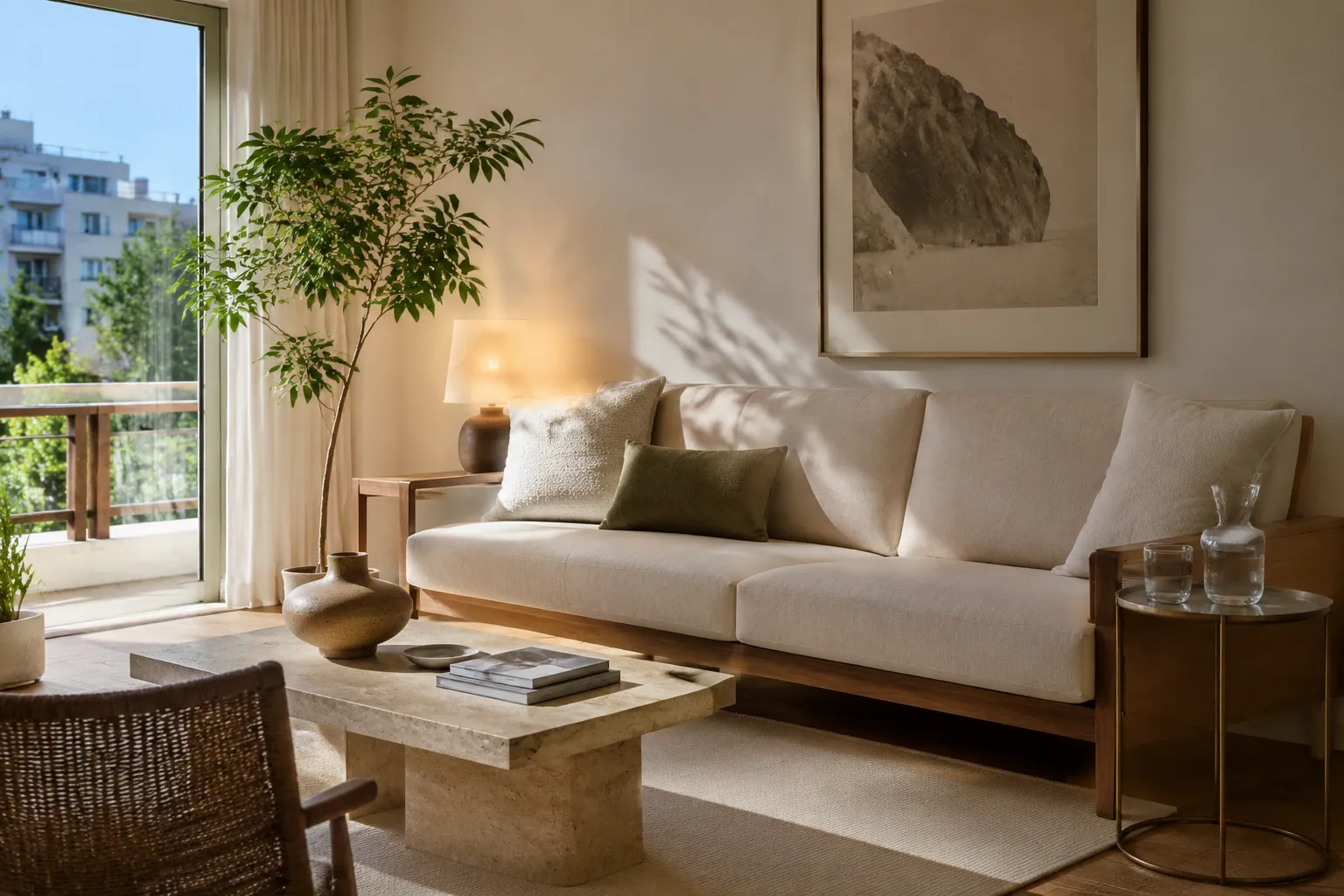
A wooden chair is wood literally. A tall, narrow, green rectangle is wood figuratively—growth, spring, a column that stands up. A lamp is fire even when it is not a hearth. A ceramic bowl is earth. A round white clock is metal. A glass pane or a dark-blue path of tiles is water. You can furnish a room with all five forces and never own a fountain.
That split is the whole method. If you only hunt for “a plant, a candle, a rock, a coin, a fishbowl,” you miss the walls, the lighting, and the shape of the table. If you only chant colors, you miss the stove that is already fire.
Each force also has a job in daily language:
- Wood grows and starts. New plants, vertical lines, green.
- Fire heats and shows. Light, red, triangles, sharp peaks.
- Earth steadies. Clay, square, beige, late-summer weight.
- Metal cuts and organizes. Round, white, steel, autumn clarity.
- Water moves and reflects. Glass, deep blue or black, irregular edges, a path that can turn.
You do not need a personal “birth element” to start. Tonight you photograph the room.
The productive cycle
The productive cycle (also called the creative or sheng cycle) is the order in which one process feeds the next:
Water → Wood → Fire → Earth → Metal → Water
The picture is agricultural, not mystical:
- Water nourishes plants (wood).
- Wood fuels flame (fire).
- Fire leaves ash that becomes soil (earth).
- Earth compresses and yields ore (metal).
- Metal surfaces gather dew as they cool (water).
Connie Spruill calls this a mother–child sequence: the mother should stay larger than the child. A harmonious room often has a predominant force, a smaller force that it produces, and splashes of the other three. Earth with a little metal (earth “gives birth” to metal) reads calmer than equal blocks of all five fighting for the same wall.
To strengthen a force, add that force or the one that produces it:
| You want more of | Add it, or add its “mother” |
|---|---|
| Wood | Wood, or water |
| Fire | Fire, or wood |
| Earth | Earth, or fire |
| Metal | Metal, or earth |
| Water | Water, or metal |
A north-facing entry that already feels like water (dark mat, glass sidelight) can take white or gray metal as nourishment—without a pump. The bagua map later pairs directions with these forces; you do not need that overlay to understand the cycle.
The controlling cycle (and the gentler reduction cycle)
The controlling cycle (destructive or ke cycle) is the pentagram of check:
- Water douses fire.
- Fire melts metal.
- Metal cuts wood.
- Wood depletes earth (roots drink the soil).
- Earth dams water.
Spruill’s metaphor is father disciplines child: useful when one force has taken the whole room. It also adds tension. A red throw on an all-white metal sofa will work—the eye stops—but it can feel like a reception desk, not a place to sit for hours.
That is why she also teaches a milder reduction cycle: the child exhausts the mother. The child is the next force in the productive cycle; it drains the parent without a clash:
| Excess of | Gentler drain (child exhausts mother) | Stronger check (controlling cycle) |
|---|---|---|
| Wood | Fire (burns the fuel) | Metal (cuts) |
| Fire | Earth (smothers) | Water (douses) |
| Earth | Metal (compresses) | Wood (depletes) |
| Metal | Water (erodes / condenses away) | Fire (melts) |
| Water | Wood (drinks) | Earth (dams) |
Rule of thumb at Juhe: if a process is a bit loud, drain it first (reduction). If it has eaten the room, use the controlling partner—in a small dose. Do not fight metal with a wall of red triangles, and do not fight wood with a hardware store of blades.
For furniture, Spruill’s mother–child drain is the one you can test with a lamp.
What each element looks like at home

Literal and figurative at once: plant, lamp, ceramic, metal bowl, glass of water.
Read a room on material, color, and shape. Season and direction are classical tags, not a shopping list you must complete tonight.
| Element | Quality | Color | Shape | Season | Direction | Literal | Figurative |
|---|---|---|---|---|---|---|---|
| Wood | Growth, beginnings | Green | Column, tall rectangle | Spring | East | Plants, timber | Vertical bookshelves, leafy prints |
| Fire | Heat, display | Red, strong orange | Triangle, jagged peak | Summer | South | Stove, lamp, candle | Pointed art, sharp peaks |
| Earth | Stability | Yellow, beige, brown | Square, low and wide | Late summer | Center | Clay, ceramic, stone, brick | Square tables, sandy textiles |
| Metal | Precision, clarity | White, gray, gold | Round, oval, sphere | Autumn | West | Steel, bronze, coins | Round clocks, white walls |
| Water | Flow, reflection | Black, dark blue | Wave, irregular | Winter | North | Water, glass, mirror | Curved paths, glossy dark floors |
Rooms have jobs. Juhe’s working bias (not medical advice):
- Bedroom leans earth and metal: steady, quiet, clear. Fire stays a splash (one warm lamp), not a theme. Full bedroom geometry—command position, mirrors—lives on bedroom feng shui.
- Kitchen already is fire (the hob) plus water (the sink). Do not stack more red, more triangles, and decorative open flame. Kitchen stove rules belong on Home Design, not this page.
- Desk leans metal: edges you can think on. Use the desk position tool as a slice of backing and door view; this article only names the force.
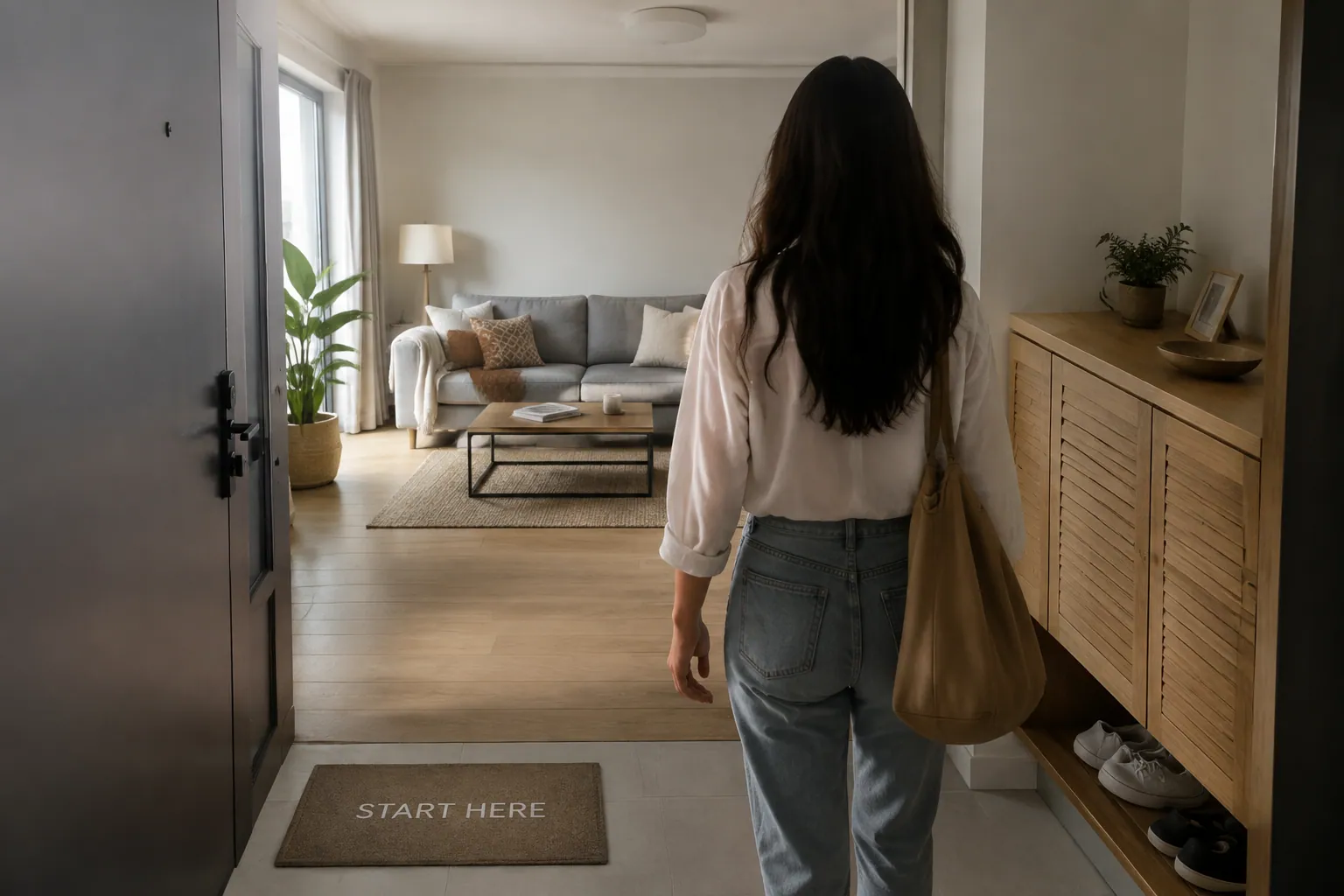
- Entry and circulation want water as flow: a path that can turn and a door that opens fully. That is not “you must build a fountain.” Qi as mouth-and-path is already in What is feng shui.
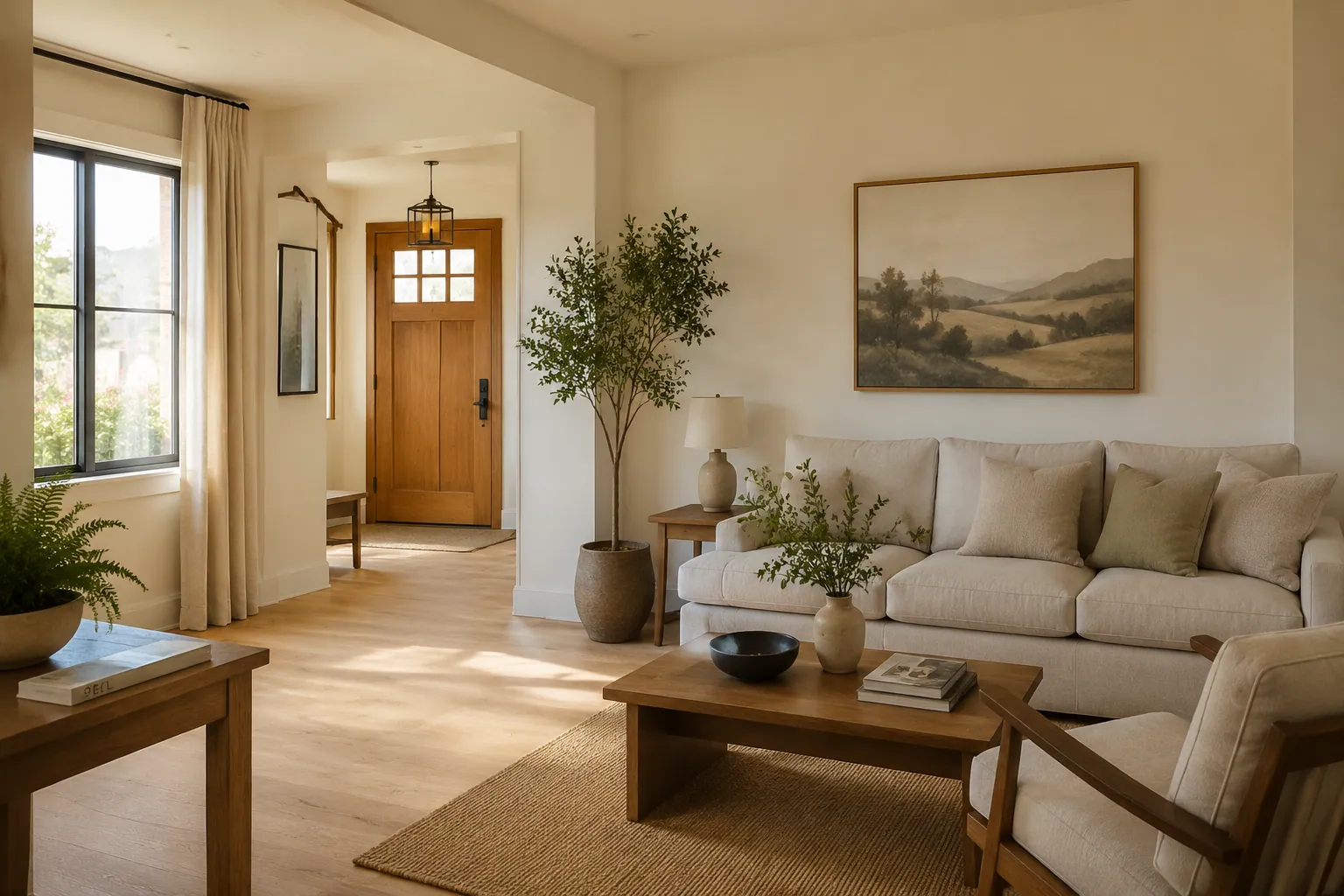
You do not have to place five matching ornaments in every room. A kitchen already holds fire, water, metal utensils, earthenware, and wood cabinets if you look.
A worked room: too much metal
Hold one picture for the rest of the page: a study that is all white metal. White walls, white ceiling, chrome lamp, glass-top desk with steel legs, gray metal shelves, no timber, no warm bulb. It photographs as “clean.” After three hours it can feel like a clinic.
Mistake one: putting a single glass of water on the desk and calling the room balanced. In the productive cycle, metal already generates water. A cup is the child—a token drain. When metal has eaten every surface, the child is too small. The room still reads as one force.
What the controlling cycle asks: a little fire to melt metal. Not a bonfire. A warm lamp, a small terracotta shade, a rust or rust-red spine of books, one triangular desk calendar. The eye now has heat against the chrome. That is the wiki example: a fishbowl will not save an all-metal room; fire will.
Reduction still has a job. If the study is only slightly cold (white walls, but a wood floor and a plant), a dark-blue blotter or a glass object can drain metal more gently. Choose drain first; choose fire when the photograph is nothing but white and steel.
Second picture: a green plant wall—too much wood. Growth everywhere, no rest. A little fire (one lamp, not a string of red lanterns) burns some of the fuel—reduction, child exhausting mother. If the wall is a forest and the desk has vanished, metal (a round white clock, a steel tray) cuts. Do not start with a hardware display.
Same logic, two rooms: name the surplus, then pick drain versus check.
Over and under: a five-minute check
This is not a shopping list. Walk one room tonight and write five lines.
- Material. What is most of the mass? Timber, clay, steel, glass, fabric? If 80% is one family, you have a surplus—not a personality type.
- Color. White/gray walls plus white furniture is a metal stack even if the sofa is “linen.” Green on every wall is a wood stack. Count areas, not paint chips.
- Shape. Columns and tall bookcases (wood); peaks and triangles (fire); low squares (earth); circles (metal); waves and amoebas (water). A room of only sharp peaks is loud even in beige.
- Light. Overhead LEDs at full blast are fire-plus-yang. A desk with no lamp at all is under-fired for work. Sleep wants less fire, not a second spotlight on the pillow.
- Blockage. Piles in the path are not “missing water.” They are a stuck room. Clear the route before you add a wavy rug to “activate north.” Circulation is water as movement, not as a gadget.
Under-supply is the inverse: a basement study with no daylight and no lamp is short of fire for thinking; a bedroom of only glass and mirrors is short of earth’s weight. Add the missing process or its mother—small.
If the bed is in the door’s rush, five-element paint will not save the night. Fix form first; then tune forces.
What five-element feng shui is not
It is not a promise that five ornaments will change your luck. Objects mark a process after the path and the backing work.
It is not a medical system. Classical tables pair wood with liver and anger, fire with heart and joy, earth with spleen/stomach and pensiveness, metal with lungs and grief, water with kidneys and fear. Treat those as a memory palace from Chinese cosmology—not a diagnosis, not a diet, not a reason to skip a clinician. Juhe does not sell “eat this for your organ.”
It is not a requirement to display all five as matching kits. Representation can be figurative and tiny. Forcing five souvenirs into a studio is clutter with a theory.
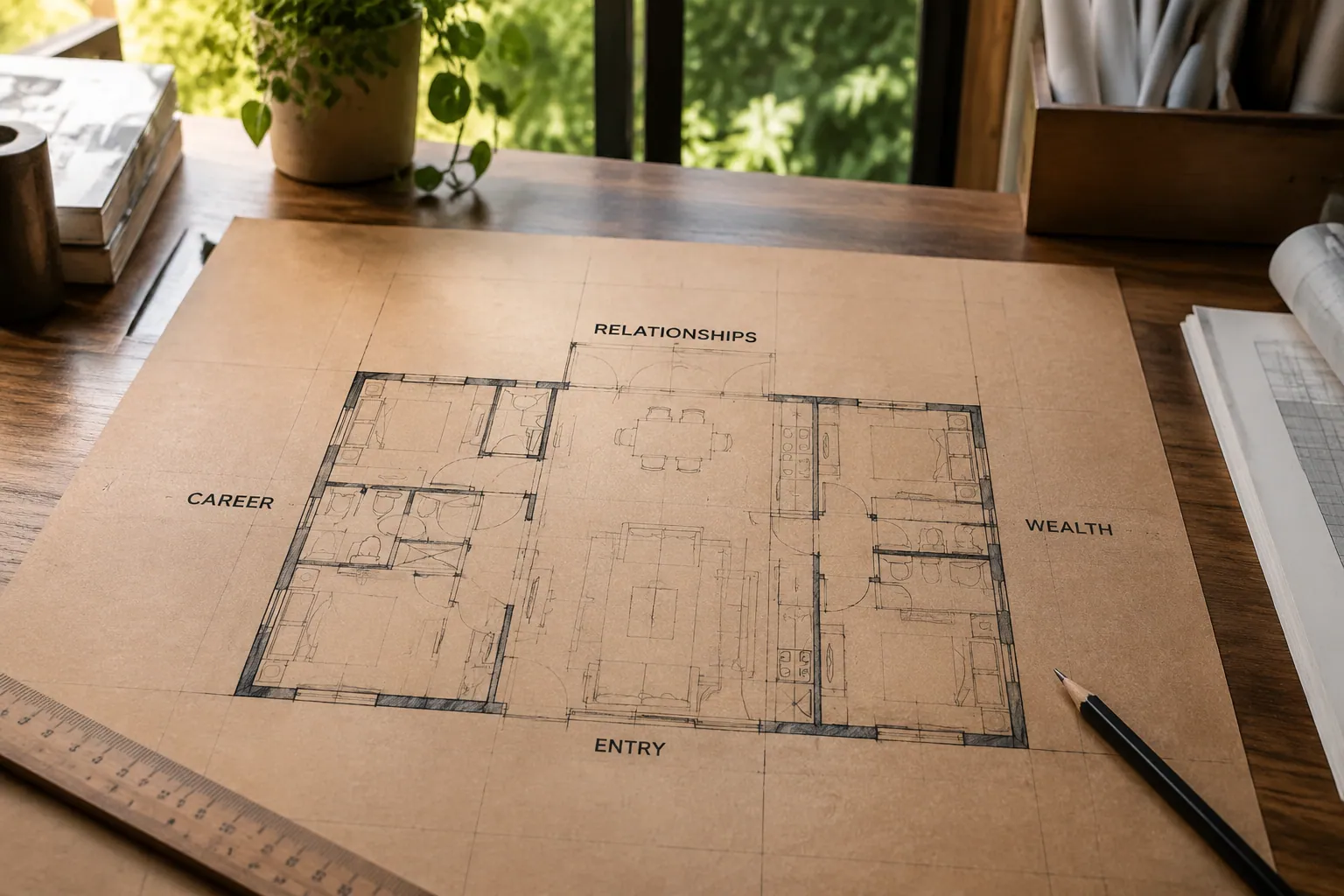
It is not the bagua. The bagua overlays life topics on a plan; the five forces are the materials language that some bagua corners then use. You can balance a study without placing “wealth” in the far-left corner.
It is not a full kitchen or bedroom tutorial. Stove facing, command position, and beam-over-bed belong on Home Design.
FAQ
What is wu xing?
Wu xing is the Chinese name for these five processes. English says “five elements”; the older sense is five movements. Same cycle: produce, control, and—when needed—drain.
Is the productive cycle the same as the creative cycle?
Yes, in practice. Productive, creative, generating, sheng: Water → Wood → Fire → Earth → Metal → Water. Different books, one ring.
What is the destructive cycle in feng shui?
The controlling sequence: water douses fire, fire melts metal, metal cuts wood, wood depletes earth, earth dams water. Use it when one force has taken the room. Prefer reduction (child drains mother) when the surplus is mild.
Can colors treat illness?
No. Color can change how stimulating a room feels. Traditional organ–emotion charts are not treatment. Pain, sleep disorders, and mood that will not lift belong with a clinician.
Do I need all five elements in every room?
You need the room’s job supported, not a boxed set. A kitchen already mixes fire and water. A bedroom can be mostly earth and metal with tiny fire. Splashes of the rest are enough; five identical figurines are not a test.
How do the five elements relate to the bagua?
Some systems assign a force to each trigram or compass sector (east wood, south fire, and so on). The bagua page covers where those sectors sit on a plan. This page covers what the forces are. Start here if the color charts on bagua pages feel arbitrary.
Where should I go after this page?
Stay on Knowledge: beginner guides, What is feng shui, bagua. Room how-tos: Home Design. Desk geometry only: desk position. Score your own plan with a Free Home Check—self-serve, not a booking.
Next step
Keep one test: name the surplus (the all-white study, the plant wall), then choose drain or check—warm light against too much metal; a little fire, then metal, against too much wood. Continue the guide path, or put the walls on a plan with Analyze.
Synthesized from Juhe’s feng shui knowledge base: five-elements concept pages (processes vs Western substances), productive / controlling / reduction cycles, and five-elements-in-décor correspondences. Traditional organ–emotion tables are memory aids, not medical claims.